

Judges 9 by Sound Mind Bible Study
(Retold for understanding and storytelling purposes)
The Story
There once was a man named Abimelech, the son of Gideon, the great hero who led Israel to victory over the Midianites. But Abimelech was not like his father. His mother was from the city of Shechem, a place known for its wealth, influence, and idol worship.
After Gideon died, Israel had peace for a while, but Abimelech had a burning desire for power. He thought to himself, “Why should I not be the ruler I am Gideon’s son too.”
Only problem, Gideon had seventy sons. That is a lot of competition.
So Abimelech went to Shechem, where his mother’s relatives lived, and started campaigning like a politician. He told them, “Hey, you are my family. Would you rather have seventy rulers telling you what to do or just one who is your own blood”
They liked the sound of that.
Now Shechem had a big temple called the Temple of Baal Berith, which means “Lord of the Covenant.” It was supposed to represent a covenant god, but not the true God of Israel. This temple mixed Israel’s covenant idea with pagan worship. The people of Shechem had completely twisted something holy into something false.
So they took silver from that temple and gave it to Abimelech to fund his rise to power. He used that money to hire a group of violent men to help him.
Abimelech went to his father’s house and killed all seventy of his brothers on one stone. Every single one, except for the youngest, Jotham, who escaped and ran for his life.
Then the people of Shechem crowned Abimelech as king beside the oak tree near their city. He was now the first man in Israel to call himself king.
Jotham’s Warning
When Jotham heard what had happened, he climbed up Mount Gerizim, the mountain that overlooks Shechem, and shouted down to the people, “Listen to me, people of Shechem, so that God may listen to you.”
Then he told them a parable, a story with a hidden meaning:
“Once upon a time, the trees wanted to choose a king.
They went to the Olive Tree and said, ‘Be our king.’
But the Olive Tree said, ‘Why would I give up producing my oil that honors God and man’
Then they went to the Fig Tree. ‘Be our king,’ they said.
The Fig Tree said, ‘Why would I stop producing my sweetness and good fruit’
Then they went to the Vine and said, ‘Be our king.’
The Vine said, ‘Why would I stop making wine that cheers God and man’
Finally, they went to the Bramble, a thornbush, and said, ‘You be our king.’
The Bramble laughed and said, ‘Sure, come take shelter in my shade. But if you do not, fire will come out from me and burn down the mighty trees.’”
Jotham’s voice echoed across the valley as he cried, “You chose a thornbush for a king, and now you will get burned. If you acted with truth and honor in making Abimelech your king, may you be blessed. But if not, may fire come out from Abimelech and destroy you, and fire from you destroy him.”
Then he ran for his life.
The Thornbush Catches Fire
For three years, things seemed peaceful. Abimelech ruled over Shechem, and the people pretended everything was fine. But then, just like Jotham warned, the fire began to burn.
God sent a spirit of division between Abimelech and the people of Shechem. They started turning against each other, spreading lies, and plotting behind one another’s backs.
A man named Gaal started stirring up trouble, saying, “Who is Abimelech anyway Why should we serve him”
Abimelech heard about this rebellion and marched on Shechem with his army. He attacked the city, defeated Gaal, and then turned his anger on everyone else.
He destroyed the city, killed its people, and burned their tower with about a thousand men and women trapped inside. It was a horrifying sight, smoke rising where homes and lives had once been.
But Abimelech was not finished. After destroying Shechem, he wanted to make sure no one would ever rebuild it. So, as a final act of revenge, he scattered salt over the ruins of the city.
Now, this was not because he wanted to make the ground taste better. It was a symbolic curse. In those times, salting the ground meant declaring a place forever ruined, cursed, and barren. The salt stood for permanent desolation, a way of saying, “May nothing good ever grow here again.” It was Abimelech’s dark, prideful way of marking the city as a wasteland. Ironically, the very curse he acted out would soon fall on him.
The Fall of the Thornbush King
After burning Shechem and scattering salt, Abimelech marched to another nearby town called Thebez. Thebez was close to Shechem, but it was not described as a city that worshiped Baal. The Bible does not say anything about temples or idols there, only that it was a city Abimelech decided to attack next.
The people of Thebez wanted nothing to do with his reign of terror. When he came to destroy them, they ran into a tall strong tower in the middle of the city and locked the doors.
Abimelech, angry and full of pride, said, “Fine I will burn this tower down too.” So he and his men gathered wood and went right up to the entrance to set it on fire.
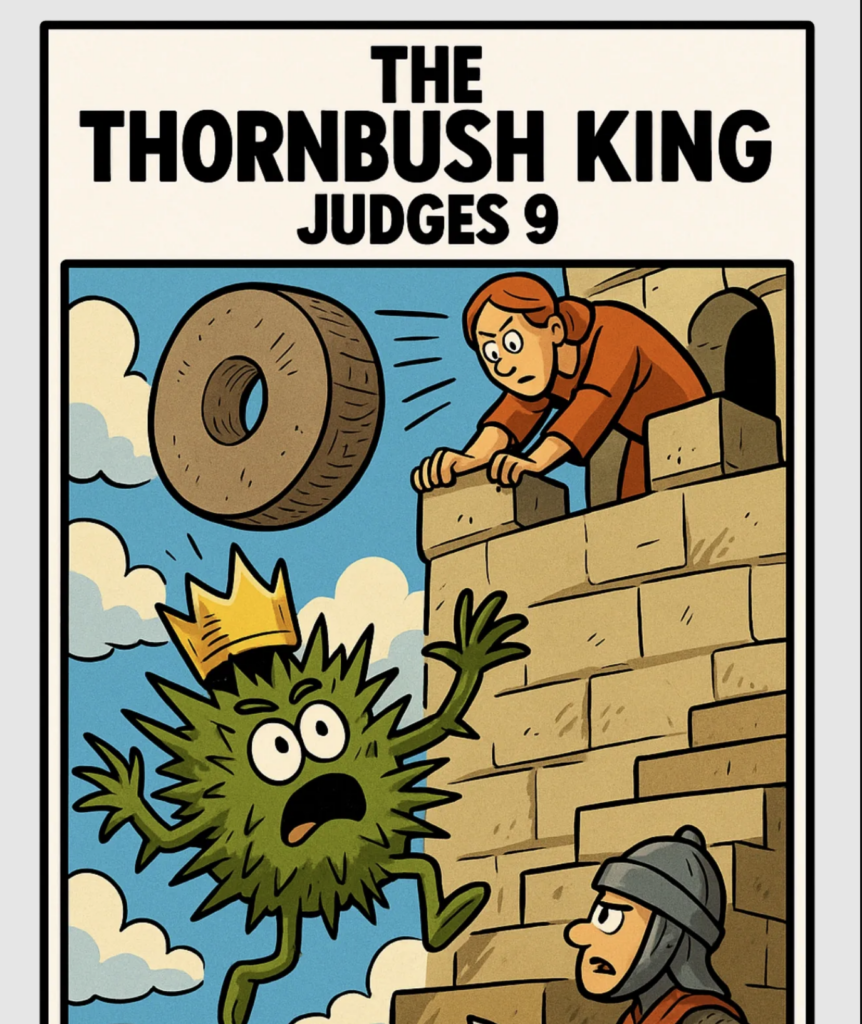
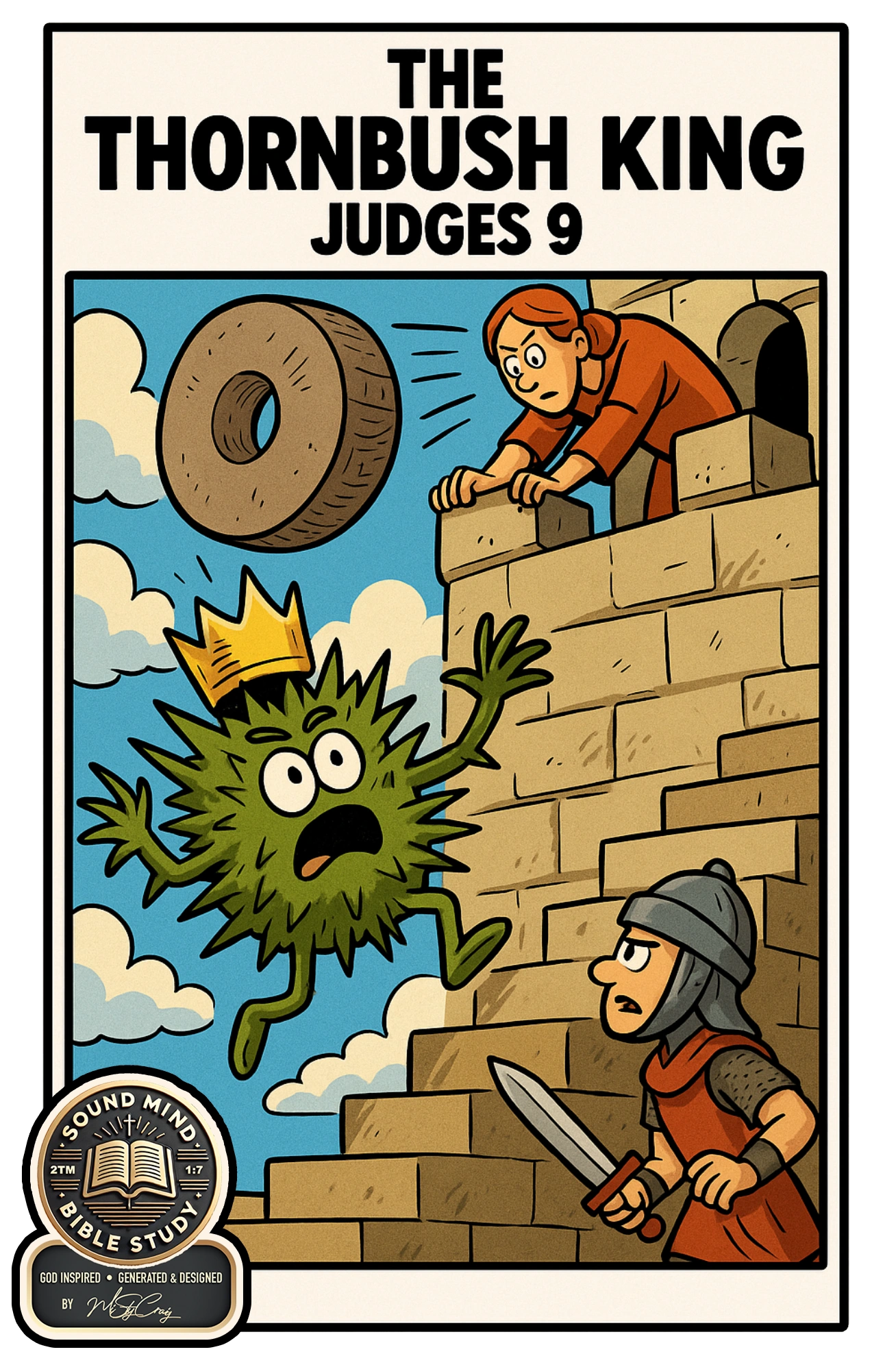
But before he could, a woman standing at the top of the tower looked down, grabbed a millstone, and dropped it straight down.
It hit Abimelech on the head and crushed his skull.
Wounded and humiliated, Abimelech called his armor bearer and said, “Quick, draw your sword and kill me, so no one can say a woman killed me.”
And so he died by the sword, but the truth was still told, a woman had struck him down.
When the Israelites saw that their ruthless king was dead, they all went home. His story ended just as Jotham had prophesied. The bramble king and the trees that crowned him were both destroyed by the fire they started.
The Lesson of the Thornbush King
Jotham’s parable came true to the last detail.
The olive, fig, and vine trees represented good leaders, humble, fruitful, and dedicated to serving others. They produced life and blessing.
The bramble, on the other hand, represented the kind of leader who gives nothing, demands everything, and ultimately burns everyone around him.
Shechem had chosen a bramble, and they got exactly what they asked for: destruction. Abimelech’s pride, violence, and false alliances consumed everything he touched, even himself.
Takeaway
So if you ever need to remember Judges Chapter 9, here is the short version:
“The son who wanted power became a thornbush king, and everyone who trusted him got burned.”
Or this one:
“When you plant a thornbush and call it a tree, do not be surprised when your garden catches fire.”
That is the story of Judges Chapter 9 — a reminder that even ancient stories can still speak today about pride, false leadership, and how God always brings justice in the end.