

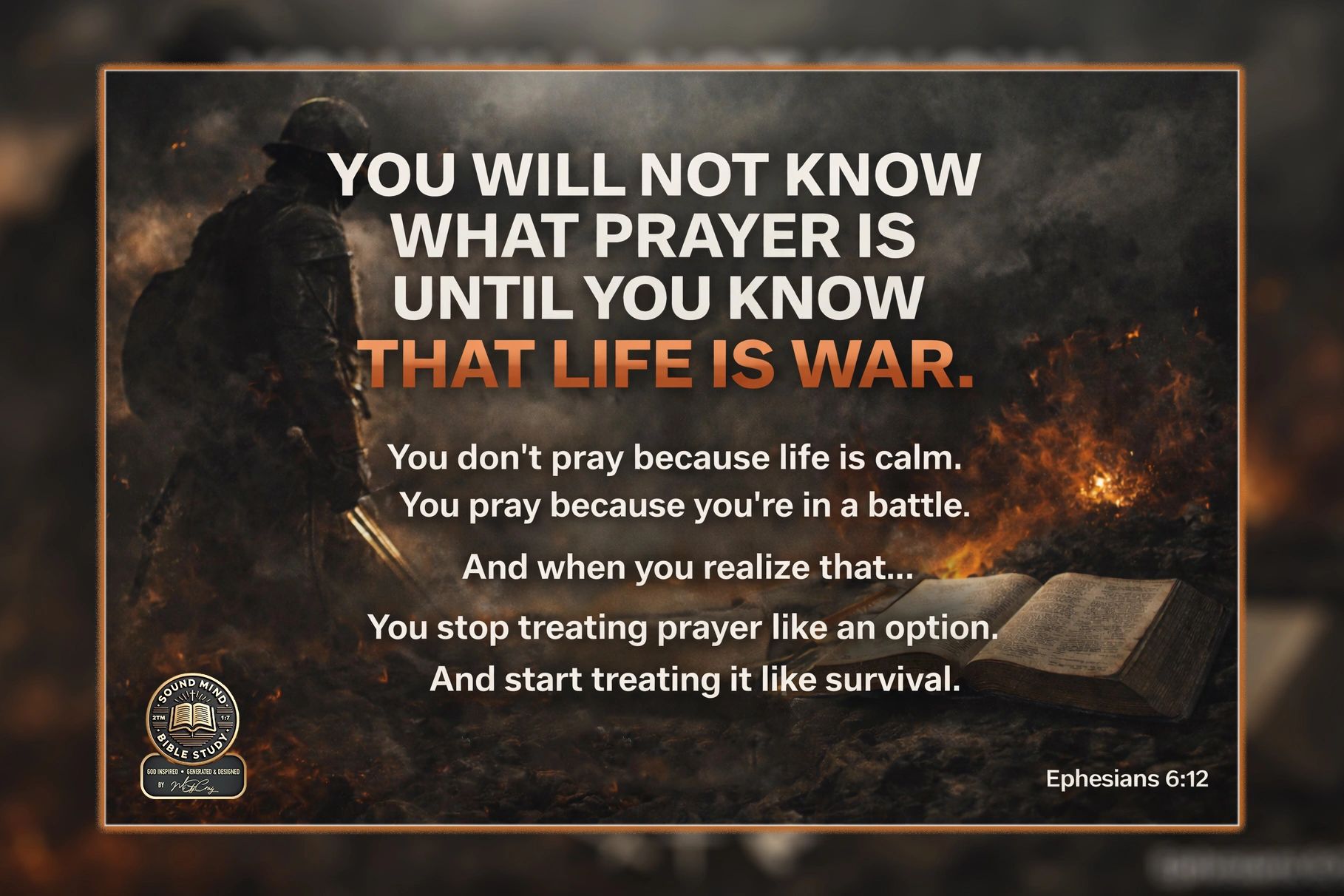
NOT PASSIVE.
NOT NEUTRAL.
NOT OPTIONAL.
Understanding Prayer as Spiritual Warfare
Opening Focus
Most people do not misunderstand prayer because they lack faith.
They misunderstand prayer because they misunderstand the battlefield.
Life is not passive.
It is not neutral.
And it is not calm by default.
There is resistance.
There is pressure.
There is opposition to truth, to peace, to identity, to obedience.
If life is a battlefield, then prayer is not decoration.
It is defense.
Ephesians 6:12
“For we wrestle not against flesh and blood, but against principalities, against powers, against the rulers of the darkness of this world, against spiritual wickedness in high places.”
Paul makes something clear.
The war is real.
But it is spiritual.
And spiritual battles require spiritual response.
Old Testament Foundations of Spiritual Warfare
1. Moses and Amalek
Exodus 17:8–13
Israel had just crossed the Red Sea.
Deliverance had happened.
Freedom had begun.
And immediately, Amalek attacked.
As long as Moses’ hands were raised, Israel prevailed.
When his hands dropped, the enemy gained ground.
The battle in the valley was physical.
But the victory was tied to what happened on the mountain.
Prayer was not symbolic.
It was strategic.
2. Daniel in Babylon
Daniel 6
Daniel lived under a hostile decree.
He knew praying could cost him his life.
And yet he prayed anyway.
He did not react with panic.
He did not adjust to culture.
He remained spiritually engaged.
Prayer was not passive.
It was allegiance.
3. David Before Battle
1 Samuel 23:2
“David inquired of the Lord…”
Before fighting, David sought alignment.
Courage without guidance is recklessness.
Prayer positioned him before action.
What This Means Today
We do not fight with swords.
But we fight:
Anxiety
Temptation
Comparison
Cultural pressure
Distraction
Weariness
Identity confusion
And many believers try to fight emotionally what must be fought spiritually.
Prayer is not retreat.
It is reinforcement.
What would change if I saw prayer as survival?
Closing Anchor
Ephesians 6:18
“Praying always with all prayer and supplication in the Spirit…”
Prayer is listed with the armor.
It activates what God provides.
Historical Background: Amalek (Referenced in Exodus 17)
The Amalekites were descendants of Amalek, the grandson of Esau (Genesis 36:12).
They were desert raiders known for sudden attacks.
According to Deuteronomy 25:17–18, they targeted the weak and weary at the back of Israel’s camp.
They attacked immediately after Israel’s deliverance from Egypt.
Because of this, they became symbolic in Scripture of relentless opposition and hostility toward God’s covenant people.
In Exodus 17, their attack demonstrates a key principle:
Opposition often follows breakthrough.
And victory requires spiritual posture.
Who Were the Amalekites?
The Amalekites were a nomadic warrior tribe in the ancient Near East.
Their Lineage
They descended from Amalek, who was the grandson of Esau.
- Abraham
- Isaac
- Esau
- Eliphaz
- Amalek
You can see this in Genesis 36:12.
That means the Amalekites were actually distant relatives of Israel. Esau was Jacob’s brother. So this was family conflict generations later.
Why Were They Feared?
1. They Were Desert Raiders
The Amalekites were not a settled city nation.
They were mobile.
Fast.
Strategic.
They lived in the wilderness regions south of Canaan and were known for sudden attacks.
They were skilled at guerrilla-style warfare long before that term existed.
2. They Attacked the Weak
In Deuteronomy 25:17–18, Moses reminds Israel what Amalek did:
They attacked the rear of Israel’s camp.
They targeted the weak, the tired, the stragglers.
That is why they became symbolic of cruelty and spiritual opposition.
They didn’t engage honorably.
They preyed on vulnerability.
3. First Enemy After Deliverance
Exodus 17 is powerful because Amalek is the first nation to attack Israel after the Red Sea.
Israel had just experienced deliverance.
And immediately — opposition.
That pattern matters spiritually.
Deliverance does not eliminate warfare.
Sometimes it exposes it.
Why This Matters for Your Study
Amalek became more than just a tribe in Scripture.
They symbolized:
- Relentless opposition
- Attacks against the vulnerable
- Resistance after breakthrough
That is why Moses raising his hands in prayer mattered so much.
The battle was physical.
But the outcome was spiritual.
A Deeper Layer
Later in Scripture, God tells Israel to remember Amalek’s aggression.
Not because of personal vengeance.
But because Amalek represented sustained hostility toward God’s covenant people.
They were not just a random tribe.
They were persistent enemies.